Please make sure you have all of the following prior to the test day:
Training records, Logbook, Medical Certificate Class 1 or 2, AELP (English Language Assessment) and KDR's completed by a Flight Instructor.
The following forms will need to be available from the school or Flight Examiner:- 61-PLA, 61-1488, 61-9 PIC, ASIC copy
You will need to either have made any applicable payment to CASA for the licence on line or have a credit card available to complete the details on the application form.
Minimum age – the examiner must sight one of the following documents to verify that the applicant is at least 17 years of age:
Australian driver licence, CASA issued medical certificate, Australian passport, Australian birth certificate.
Eligibility certification – the examiner must ensure that an appropriate person of the training provider has certified in writing that the applicant is eligible to take the flight test.
Test Duration (Approximate)
Oral questioning 45min-1 hour
Flight Test 2.3 hrs
Quick pre-test checklist (bring this with you)
Today’s W&B (T/O and landing) within limits.
Performance tables computed (runway, surface, DA, obstacles).
Flight Plan with headings/times/fuel, diversion blank ready.
NOTAMs/Weather printed or cached; alternates/last-light if relevant.
EFB & backups (power, paper minima, critical frequencies, LSALT method).
Standard briefs ready: departure, diversion, PFL/precautionary, approach/landing gates.

General guidance for Knowledge Assessment of CASA Flight Tests
When sitting any category of oral examination for a flight test the Flight Examiner may ask you any questions up to and including the category of license for which you are presenting.
Generally Flight Examiners will restrict their questioning to the knowledge requirements of the MOS Schedule 5 listed on the relevant flight test form.
The best way to prepare for the oral component of a flight test used is to study the flight test form and the subject matter carefully and thoroughly well in advance of the scheduled flight test date.
This will enable you to sit the test with the level of confidence you require and the of level of knowledge you require to satisfy the Flight Examiner.
If you answer questions correctly and without hesitation to the satisfaction of the Flight Examiner, the questioning will be brief. If however, you are unsure of the answers and make mistakes the Flight Examiner will go further with the questioning.
Flight examiners will also examine your KDR's (Knowledge Deficiency Reports) and may ask questions about the deficient items even though a previous flight instructor has checked you on these items. Make sure that you understand where you went wrong in the written exams and study the areas carefully because questions may be asked about these topics.
When answering questions, take a moment to think about what the Flight Examiner is actually asking you. Often candidates do not listen to the question and start talking about something else. The questions the flight examiner asks will be clear, simple and unambiguous. A simple question requires a simple answer - just answer the question and do not offer any more information. If the Flight Examiner requires further information they will ask for it. If you do not understand the question seek clarification before answering.
MOS Schedule 2 Competency Standards NTS1
NTS 1 Examination items for every flight test!
NTS1 Non-technical skills 1
1 Unit description
This unit describes the knowledge and skills required to manage a safe flight.
2 Elements and performance criteria
2.1 NTS1.1 – Maintain effective lookout
(a) maintain traffic separation using a systematic visual scan technique at a rate determined by traffic density, visibility and terrain;
(b) maintain radio listening watch and interpret transmissions to determine traffic location and intentions;
(c) perform airspace-cleared procedure before commencing any manoeuvre.
2.2 NTS1.2 – Maintain situational awareness
(a) monitor all aircraft systems using a systematic scan technique;
(b) collect information to facilitate ongoing system management;
(c) monitor flight environment for deviations from planned operations;
(d) collect flight environment information to update planned operations.
2.3 NTS1.3 – Assess situations and make decisions
(a) identify problems;
(b) analyse problems;
(c) identify solutions;
(d) assess solutions and risks;
(e) decide on a course of action;
(f) communicate plans of action (if appropriate);
(g) allocate tasks for action (if appropriate);
(h) take actions to achieve optimum outcomes for the operation;
(i) monitor progress against plan;
(j) re-evaluate plan to achieve optimum outcomes.
2.4 NTS1.4 – Set priorities and manage tasks
(a) organise workload and priorities to ensure optimum outcome of the flight;
(b) plan events and tasks to occur sequentially;
(c) anticipate events and tasks to ensure sufficient opportunity for completion;
(d) use technology to reduce workload and improve cognitive and manipulative activities.
2.5 NTS1.5 – Maintain effective communications and interpersonal relationships
(a) establish and maintain effective and efficient communications and interpersonal relationships with all stakeholders to ensure the optimum outcome of the flight;
(b) define and explain objectives to stakeholders;
(c) demonstrate a level of assertiveness that ensures the optimum completion of the flight.
3 Range of variables
(a) simulated conditions may be used where appropriate.
4 Underpinning knowledge of the following:
(a) effective communication under normal and non-normal circumstances;
(b) task management.
MOS Schedule 2 Competency Standards NTS2
NTS 2 Examination items for every flight test!
NTS2 Non-technical skills 2
1 Unit description
This unit describes the knowledge and skills required to recognise, direct and manage threats and errors during flight operations.
2 Elements and performance criteria
2.1 NTS2.1 – Recognise and manage threats
(a) identify relevant environmental or operational threats that are likely to affect the safety of the flight;
(b) identify when competing priorities and demands may represent a threat to the safety of the flight;
(c) develop and implement countermeasures to manage threats;
(d) monitor and assess flight progress to ensure a safe outcome, or modify actions when a safe outcome is not assured.
2.2 NTS2.2 – Recognise and manage errors
(a) apply checklists and standard operating procedures to prevent aircraft handling, procedural or communication errors;
(b) identify committed errors before safety is affected or the aircraft enters an undesired state;
(c) monitor the following to collect and analyse information to identify potential or actual errors:
(i) aircraft systems using a systematic scan technique;
(ii) the flight environment;
(iii) other crew;
(d) implement countermeasures to prevent errors or take action in the time available to correct errors before the aircraft enters an undesired state.
2.3 NTS2.3 – Recognise and manage undesired aircraft state
(a) recognise an undesired aircraft state;
(b) prioritise tasks to ensure an undesired aircraft state is managed effectively;
(c) apply corrective actions to recover an undesired aircraft state in a safe and timely manner.
3 Range of variables
(a) Reserved;
(b) simulated conditions may be used where appropriate.
4 Underpinning knowledge of the following:
(a) effective communication under normal and non-normal circumstances;
(b) threat and error management detailing processes that can be used to identify and mitigate or control threats and errors;
(c) the application of situational awareness to identifying real or potential environmental or operational threats to flight safety;
(d) developing and implementing plans of action for the following:
(i) removing and mitigating threats;
(ii) removing and mitigating errors;
(e) undesired aircraft states, including prevention, identifying and controlling;
(f) how an undesired aircraft state can develop from an unmanaged threat or error;
(g) what aspects of multi-crew operations (if applicable) can prevent an undesired aircraft state;
(h) use of checklists and standard operating procedures to prevent errors.
(i) task management, including:
(i) workload organisation and priority setting to ensure optimum safe outcome of the flight;
(ii) event planning to occur in a logical and sequential manner;
(iii) anticipating events to ensure sufficient opportunity is available for completion;
(iv) using technology to reduce workload and improve cognitive and manipulative activities;
(v) task prioritisation and protection whilst filtering and managing real time information.
PPL Flight Test Tolerances

SECTION 1: Flight tolerances
Table 1: Aeroplane general flight tolerances – private level
Applicability
The flight tolerances in this subsection apply to the following licences and ratings:
private pilot licence;
Requirements
A person is required to perform flight manoeuvres within the flight tolerances mentioned in this table to be assessed as competent in the associated unit of competency.
Flight tolerances
Taxing aircraft ±1.5 metres of centreline
Nominated heading ±10°
Climb airspeed -0 / +5 kts
Level off from climb and descent ±150 ft
Straight and level Altitude ±150 ft IAS ±10 kts
Power descent airspeed ±10 kts
Glide -5 / +10 kts
Turns Angle of Bank ±5°
Turns onto nominated headings Heading ±10°
Steep Turn Heading ±10° Height ±150 ft
Final approach airspeed -0 / +5 kts
Landing Touchdown ±120 m Centreline tracking ±2 m
Asymmetric flight Heading – initial ±20° Heading - sustained ±5° IAS -0 +5 kts
Limited panel instrument flying Heading ±15° IAS ±10 kts or ±M0.02 Height ±200 ft
Schedule 8 Pilot Maintenance
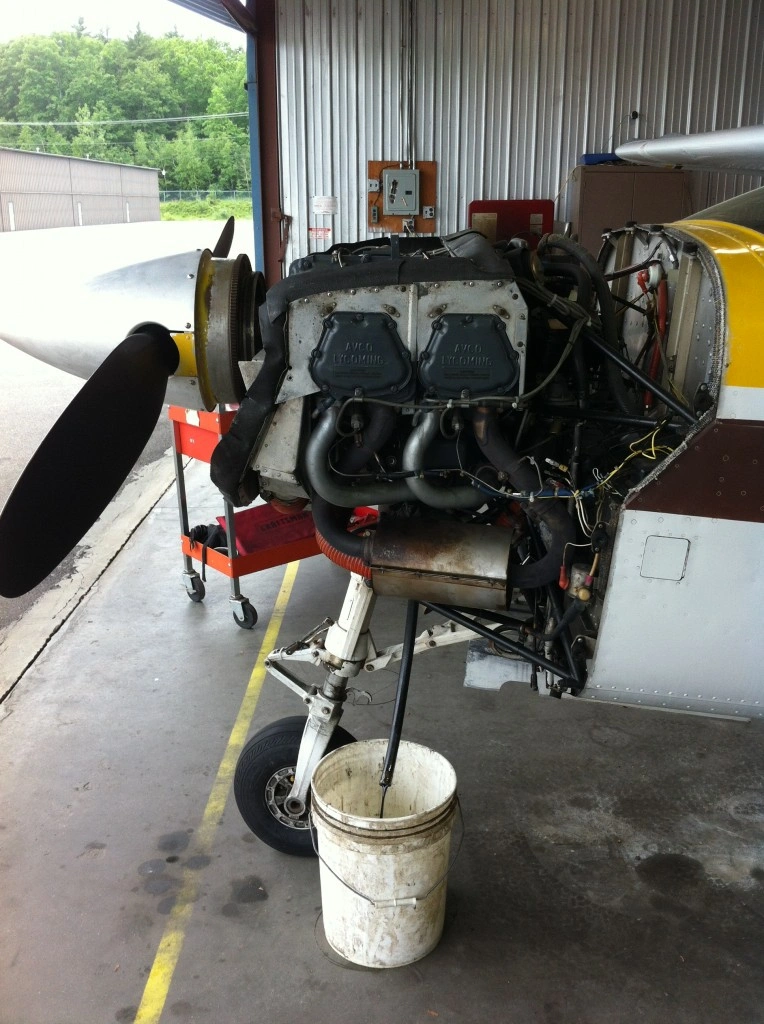
Schedule 8—Maintenance that may be carried out on a Class B aircraft by a person entitled to do so under subregulation 42ZC(4)
(subregulation 42ZC(4))
Part 1—Maintenance on Class B aircraft other than manned free balloons
1. Removal or installation of landing gear tyres, but only if the removal or installation does not involve the complete jacking of the aircraft.
2. Repair of pneumatic tubes of landing gear tyres.
3. Servicing of landing gear wheel bearings.
4. Replacement of defective safety wiring or split pins, but not including wiring or pins in control systems.
5. Removal or refitting of a door, but only if:
(a) no disassembly of the primary structure or operating system of the aircraft is involved; and
(b) if the aircraft is to be operated with the door removed—the aircraft has a flight manual and the manual indicates that the aircraft may be operated with the door removed.
6. Replacement of side windows in an unpressurised aircraft.
7. Replacement of seats, but only if the replacement does not involve disassembly of any part of the primary structure of the aircraft.
8. Repairs to the upholstery or decorative furnishings of the interior of the cabin or cockpit.
9. Replacement of seat belts or harnesses.
10. Replacement or repair of signs and markings.
11. Replacement of bulbs, reflectors, glasses, lenses or lights.
12. Replacement, cleaning, or setting gaps of, spark plugs.
13. Replacement of batteries.
14. Changing oil filters or air filters.
15. Changing or replenishing engine oil or fuel.
16. Lubrication not requiring disassembly or requiring only the removal of non‑structural parts, or of cover plates, cowlings and fairings.
17. Replenishment of hydraulic fluid.
18. Application of preservative or protective materials, but only if no disassembly of the primary structure or operating system of the aircraft is involved.
19. Removal or replacement of equipment used for agricultural purposes.
20. Removal or replacement of glider tow hooks.
21. Carrying out of an inspection under regulation 42G of a flight control system that has been assembled, adjusted, repaired, modified or replaced.
22. Carrying out of a daily inspection of an aircraft.
23. Connection and disconnection of optional dual control in an aircraft without the use of any tools for the purpose of transitioning the aircraft from single to dual, or dual to single, pilot operation.
24. Inspections or checks set out in the following documents in circumstances where the document clearly states that the maintenance may be carried out by the pilot of the aircraft and the maintenance does not require the use of any tools or equipment:
(a) the aircraft’s approved maintenance data;
(b) the aircraft’s flight manual or an equivalent document;
(c) any instructions issued by the NAA that approved the type certificate for the aircraft.
25. For an aircraft that is installed with an oxygen system for the exclusive use of ill or injured persons on an aircraft used to perform ambulance functions—replenishing the oxygen system installed on the aircraft.
PPL Flight Examiner Handbook Content
Press the button below to go to the CASA website
The sections that are relevant to the PPL Flight test are Section 4 NTS 1 and NTS 2 P49-64 Assessment and Section 7 PPL Flight Test P81-89

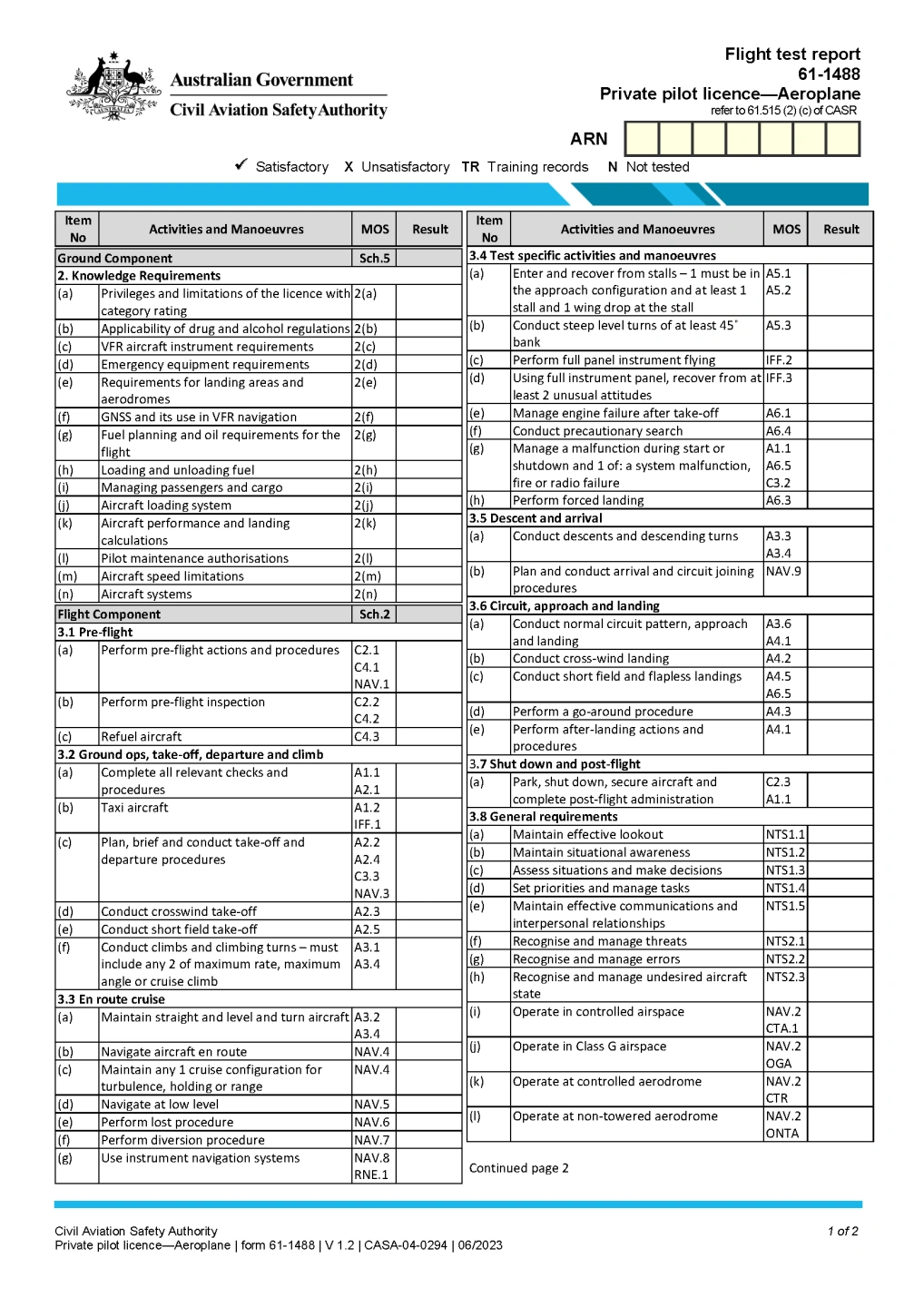
PPL Test Form 61-1488
Press the button below to go to the CASA website
This is the form that your Flight Examiner will use to assess you for the PPL Flight test.
FAQ PPL Flight Test
Frequently Asked Questions PPL
Typically ~45–60 minutes. It’s an oral, scenario-based discussion using your actual plan for today’s flight. I’ll sample performance, planning, airspace, rules, human factors, and aircraft systems.
Licence/ARN & medical, training completion evidence, logbook recency.
Aircraft docs: MR, POH/AFM, W&B data, AD/SB compliance as appropriate.
Today’s planning: route, NOTAMs, weather, alternates/last-light if relevant, T/O & landing distances, fuel plan, W&B and CG plotted.
No, paper charts and ERSA only, calculator is fine.
Your T/O and landing distances for the planned runways (incl. surface/gradient/DA corrections), climb/IAS targets, short/soft-field techniques, and W&B with today’s loading and fuel burn.
Expect questions on Class C/D/G ops, VMC minima, controlled aerodrome procedures, CTA steps, LSALT, last-light considerations if relevant, and practical alternates/fuel rules for VFR commercial-standard planning.
A clear breakdown of taxi, trip, variable (contingency), fixed reserve, and alternate/holding if applicable—plus where those numbers came from. Be ready to defend choices when weather or NOTAMs tighten margins.
Through “what-if” prompts—weather deterioration, runway closure, unserviceability, sick passenger. I’m looking for conservative, lawful choices and timely re-planning.
Enough to operate and troubleshoot in flight: engine/mixture/induction, CSU/prop, retractable landing gear if fitted, fuel system incl. fuel balancing, electrical/alternator/load-shedding, landing gear/flaps, and typical annunciations/warnings.
Can’t show within-limits W&B (T/O and landing).
Guessing performance instead of using the POH.
Confused about airspace/VMC minima or controlled aerodrome procedures.
Weak fuel/alternate reasoning or ignoring NOTAMs.
No. I’m assessing correct application of the rules and the POH to real scenarios, not rote recital.
Plan 2.3 hours airborne depending on airspace/ATC. Usual flow: start/taxi/run-up → normal/short/soft take-offs as applicable → departure/nav leg(s) → diversion → general handling (steep turns, stalls) → PFL/precautionary → circuits/landings.
As per schedule 8 Private Pilot: Altitude ±150 ft, Heading ±10°, Speed −0/+5 kt in set-piece handling; for navigation, maintain track accuracy and arrive within sensible timing tolerances (explain your updates). Stable approach criteria must be met.
You will navigate primarily with the charts, but you must cross-check (DR/timing/visual features), manage airspace steps, and handle a diversion without falling behind the aircraft. You can use any navigation aids in the aircraft, but don’t be surprised if the examiner fails them.
A realistic reroute to a nominated aerodrome/feature. I’m looking for rapid yet neat planning (heading, time, fuel, airspace), altitude choice (LSALT/terrain/CTA), and comms. Call out top-of-descent and checks.
Steep turns both directions (smooth entry/rollout, height control).
Stall series (approach/clean as briefed) with prompt, minimal-height-loss recovery and no secondary stall.
Balanced, coordinated flight throughout with lookout and trim discipline.
Expect at least: PFL (power-off glide) to a safe landing area, precautionary search & landing (low-pass inspection and circuit), and at least one systems abnormal (e.g., alternator failure, carb ice/induction, partial flap or flap-less landing). Always use Aviate–Navigate–Communicate and the checklist when time permits. Below 300ft for the PFL you must be aligned with the centreline of the runeay, ROD not more than 1,000 FPM angle of bank not more than 10 deg, but sideslipping is allowed. Once I am convinced you can make a safe landing I will call a go around. If the possibility of a safe landing is in doubt it will be a fail item and have to be retested at a later date.
You’ll demonstrate a normal circuit/landing plus short- or soft-field technique if applicable to your aircraft, and a flap-less or partial-flap landing. I’m looking for configuration discipline, correct approach speeds, stable profile, and runway control.
Unstable approaches not corrected or continued below a sensible gate.
Gross airspace infringements or unsafe airmanship.
Loss of aircraft control, repeated busts of speed/height/heading with no recognition, or poor decision-making that raises risk.
Yes. Good workload management includes asking for a vector/hold/reposition or a brief pause to set up, provided you keep flying the aircraft and communicate clearly.
We adapt—skip, resequence, or return and complete missing items later if needed. Safety and validity beat pressing on.
Completion Form
Please complete the details below to certify that you have read all of the content of this section. If you have any further questions, please contact me on 0418 260 014 or email me at douglashth@gmail.com.