Please make sure you have all of the following prior to the test day:
Training records, Logbook, Medical Certificate Class 1, AELP (English Language Assessment) and KDR's completed by a Flight Instructor.
The following forms will need to be available from the school or Flight Examiner:- 61-PLA, 61-1490, 61-9 PIC, ASIC copy
You will need to either have made any applicable payment to CASA for the licence on line or have a credit card available to complete the details on the application form.
Minimum age – the examiner must sight one of the following documents to verify that the applicant is at least 18 years of age:
Australian driver licence, CASA issued medical certificate, Australian passport, Australian birth certificate.
Eligibility certification – the examiner must ensure that an appropriate person of the training provider has certified in writing that the applicant is eligible to take the flight test.
Test Duration (Approximate)
Oral questioning 45min-1 hour
Flight Test 2.5 hrs
Quick pre-test checklist (bring this with you)
Today’s W&B (T/O and landing) within limits.
Performance tables computed (runway, surface, DA, obstacles).
Flight Plan with headings/times/fuel, diversion blank ready.
NOTAMs/Weather printed or cached; alternates/last-light if relevant.
EFB & backups (power, paper minima, critical frequencies, LSALT method).
Standard briefs ready: departure, diversion, PFL/precautionary, approach/landing gates.
Onefull lesson plans you will teach (e.g., Effects of Controls + Stalls, or Circuits + PFL/Precautionary), with diagrams, standards, common errors, risks, knock-it-off criteria. Nonimated on the day by the Examiner.
School supervision rules and what you can/can’t authorise at your grade.
Airmanship gates you’ll brief (winds/x-wind, turbulence limits, minimum heights/speeds).
Handover/takeover phrases and abort criteria memorised.
Debrief template ready to use.

General guidance for Knowledge Assessment of CASA Flight Tests
When sitting any category of oral examination for a flight test the Flight Examiner may ask you any questions up to and including the category of license for which you are presenting.
Generally Flight Examiners will restrict their questioning to the knowledge requirements of the MOS Schedule 5 listed on the relevant flight test form.
The best way to prepare for the oral component of a flight test used is to study the flight test form and the subject matter carefully and thoroughly well in advance of the scheduled flight test date.
This will enable you to sit the test with the level of confidence you require and the of level of knowledge you require to satisfy the Flight Examiner.
If you answer questions correctly and without hesitation to the satisfaction of the Flight Examiner, the questioning will be brief. If however, you are unsure of the answers and make mistakes the Flight Examiner will go further with the questioning.
Flight examiners will also examine your KDR's (Knowledge Deficiency Reports) and may ask questions about the deficient items even though a previous flight instructor has checked you on these items. Make sure that you understand where you went wrong in the written exams and study the areas carefully because questions may be asked about these topics.
When answering questions, take a moment to think about what the Flight Examiner is actually asking you. Often candidates do not listen to the question and start talking about something else. The questions the flight examiner asks will be clear, simple and unambiguous. A simple question requires a simple answer - just answer the question and do not offer any more information. If the Flight Examiner requires further information they will ask for it. If you do not understand the question seek clarification before answering.
MOS Schedule 2 Competency Standards NTS1
NTS 1 Examination items for every flight test!
NTS1 Non-technical skills 1
1 Unit description
This unit describes the knowledge and skills required to manage a safe flight.
2 Elements and performance criteria
2.1 NTS1.1 – Maintain effective lookout
(a) maintain traffic separation using a systematic visual scan technique at a rate determined by traffic density, visibility and terrain;
(b) maintain radio listening watch and interpret transmissions to determine traffic location and intentions;
(c) perform airspace-cleared procedure before commencing any manoeuvre.
2.2 NTS1.2 – Maintain situational awareness
(a) monitor all aircraft systems using a systematic scan technique;
(b) collect information to facilitate ongoing system management;
(c) monitor flight environment for deviations from planned operations;
(d) collect flight environment information to update planned operations.
2.3 NTS1.3 – Assess situations and make decisions
(a) identify problems;
(b) analyse problems;
(c) identify solutions;
(d) assess solutions and risks;
(e) decide on a course of action;
(f) communicate plans of action (if appropriate);
(g) allocate tasks for action (if appropriate);
(h) take actions to achieve optimum outcomes for the operation;
(i) monitor progress against plan;
(j) re-evaluate plan to achieve optimum outcomes.
2.4 NTS1.4 – Set priorities and manage tasks
(a) organise workload and priorities to ensure optimum outcome of the flight;
(b) plan events and tasks to occur sequentially;
(c) anticipate events and tasks to ensure sufficient opportunity for completion;
(d) use technology to reduce workload and improve cognitive and manipulative activities.
2.5 NTS1.5 – Maintain effective communications and interpersonal relationships
(a) establish and maintain effective and efficient communications and interpersonal relationships with all stakeholders to ensure the optimum outcome of the flight;
(b) define and explain objectives to stakeholders;
(c) demonstrate a level of assertiveness that ensures the optimum completion of the flight.
3 Range of variables
(a) simulated conditions may be used where appropriate.
4 Underpinning knowledge of the following:
(a) effective communication under normal and non-normal circumstances;
(b) task management.
MOS Schedule 2 Competency Standards NTS2
NTS 2 Examination items for every flight test!
NTS2 Non-technical skills 2
1 Unit description
This unit describes the knowledge and skills required to recognise, direct and manage threats and errors during flight operations.
2 Elements and performance criteria
2.1 NTS2.1 – Recognise and manage threats
(a) identify relevant environmental or operational threats that are likely to affect the safety of the flight;
(b) identify when competing priorities and demands may represent a threat to the safety of the flight;
(c) develop and implement countermeasures to manage threats;
(d) monitor and assess flight progress to ensure a safe outcome, or modify actions when a safe outcome is not assured.
2.2 NTS2.2 – Recognise and manage errors
(a) apply checklists and standard operating procedures to prevent aircraft handling, procedural or communication errors;
(b) identify committed errors before safety is affected or the aircraft enters an undesired state;
(c) monitor the following to collect and analyse information to identify potential or actual errors:
(i) aircraft systems using a systematic scan technique;
(ii) the flight environment;
(iii) other crew;
(d) implement countermeasures to prevent errors or take action in the time available to correct errors before the aircraft enters an undesired state.
2.3 NTS2.3 – Recognise and manage undesired aircraft state
(a) recognise an undesired aircraft state;
(b) prioritise tasks to ensure an undesired aircraft state is managed effectively;
(c) apply corrective actions to recover an undesired aircraft state in a safe and timely manner.
3 Range of variables
(a) Reserved;
(b) simulated conditions may be used where appropriate.
4 Underpinning knowledge of the following:
(a) effective communication under normal and non-normal circumstances;
(b) threat and error management detailing processes that can be used to identify and mitigate or control threats and errors;
(c) the application of situational awareness to identifying real or potential environmental or operational threats to flight safety;
(d) developing and implementing plans of action for the following:
(i) removing and mitigating threats;
(ii) removing and mitigating errors;
(e) undesired aircraft states, including prevention, identifying and controlling;
(f) how an undesired aircraft state can develop from an unmanaged threat or error;
(g) what aspects of multi-crew operations (if applicable) can prevent an undesired aircraft state;
(h) use of checklists and standard operating procedures to prevent errors.
(i) task management, including:
(i) workload organisation and priority setting to ensure optimum safe outcome of the flight;
(ii) event planning to occur in a logical and sequential manner;
(iii) anticipating events to ensure sufficient opportunity is available for completion;
(iv) using technology to reduce workload and improve cognitive and manipulative activities;
(v) task prioritisation and protection whilst filtering and managing real time information.
FPC Flight Tolerances

Table 2: Aeroplane general flight tolerances – professional level
Applicability
1.1 The flight tolerances in this subsection apply to the following licences and ratings:
Pilot Instructor Rating;
Requirements
2.1 A person is required to perform flight manoeuvres within the flight tolerances mentioned in this table to be assessed as competent in the associated unit of competency.
Flight tolerances
Taxing aircraft ±1.5 metres of centreline
Nominated heading ±5°
Climb airspeed -0 / +5 kts
Level off from climb and descent ±100 ft
Straight and level Altitude ±100 ft IAS ±10 kts or ±M.02
Not below minimum approach speed.
Power descent ±10 kts
Glide -5 / +10 kts
Turns Angle of Bank ±5°
Turns onto nominated headings Heading ±5°
Steep Turn Heading ±10° Height ±100 Ft
Final approach airspeed -0 / +5 kts
Landing Touchdown ±60 m
Centreline tracking ±2 m
Asymmetric flight Heading – initial ±20° Heading – sustained ±5°
IAS -0 +5 kts
Limited panel instrument flying
Heading ±15° IAS ±10 kts or ±M0.02 Height ±200 ft
FPC Flight Examiner Handbook Content
Press the button below to go to the CASA website
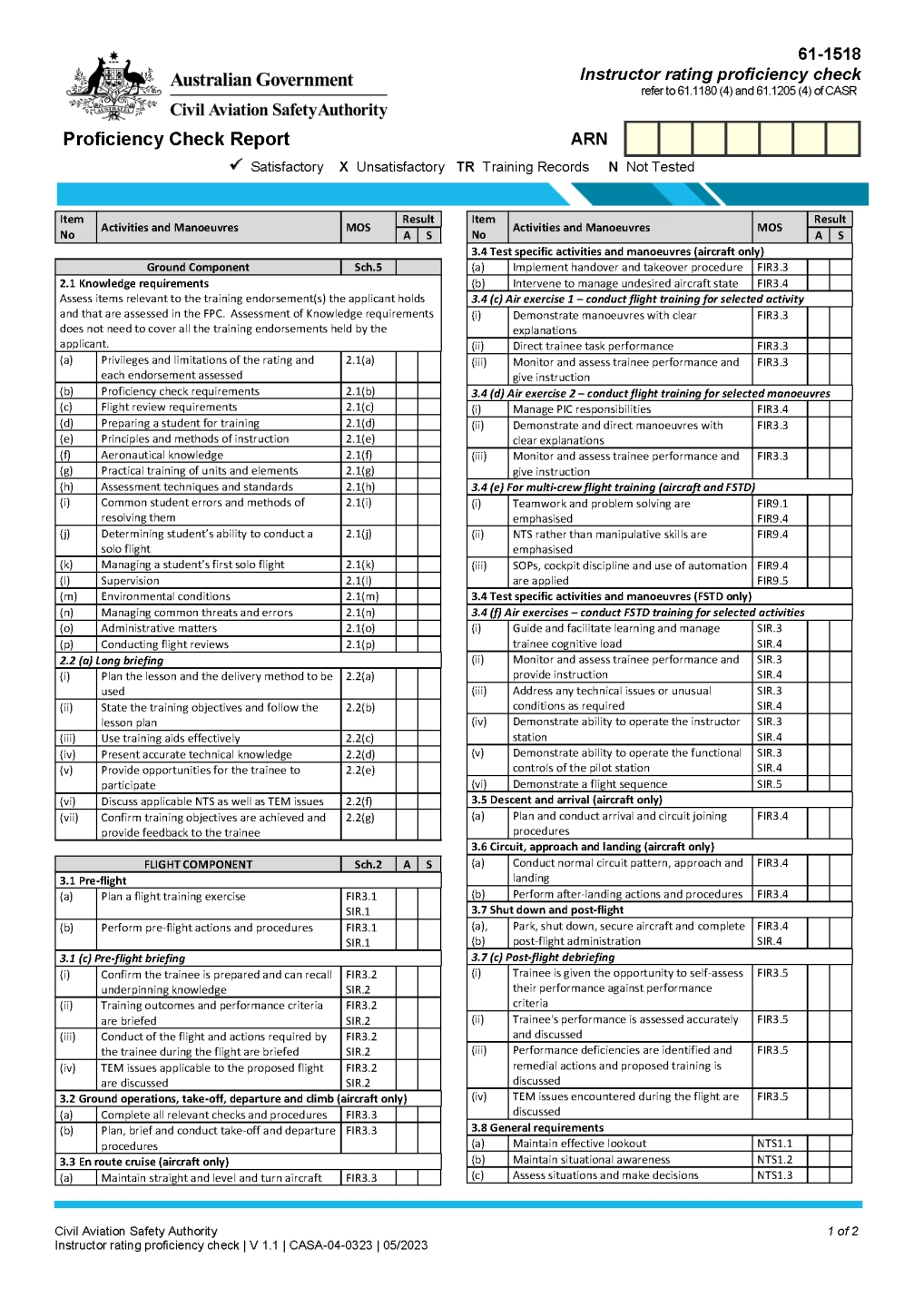
The sections that are relevant to the FPC Flight test are Section 4 NTS Assessment P49-P64 and Section 33 FPC Flight Test P323-332.

FPC Test Form 61-1518
Press the button below to go to the CASA website
This is the form that your Flight Examiner will use to assess you for the FPC Flight test.
FAQ FPC
Frequently Asked Questions FPC
To confirm you remain competent and current as an instructor within your privileges/endorsements and your school’s system. Expect 60-90 minutes of scenario-based oral, plus you’ll deliver at least one formal lesson brief.
Exactly the privileges you demonstrate (e.g., ab-initio, circuit training, stalls, PFL/precautionary, instruments for basic IF, night/NVFR if endorsed, spins/aerobatics if endorsed, multi if applicable). Items not demonstrated may not be revalidated.
Licence/ARN & medical; proof of instructor recency (hours, lessons given).
School manuals (Part 141/142 exposition/SOPs), syllabus sections for lessons you’ll teach.
Aircraft docs: MR, POH/AFM, W&B data.
Training records templates you use (how you document objectives, progress, and sign-offs).
A concise, student-centred plan: objective, pre-reqs, TEM/risks & controls, learning aids, brief outline, air exercise (demo → student practice → coaching), standards/tolerances, common errors + fixes, knock-it-off criteria, and debrief prompts.
Show practical Principles & Methods of Instruction: motivation, scaffolding, setting success criteria, guided discovery questioning, feedback that’s timely, specific, behaviour-focused, and workload management for you and the student.
That you know what you can authorise vs what needs a supervising Grade 1/2, your solo authorisation rules, and how your school’s supervision system works day-to-day (briefs, dispatch, check flights, line-of-sight/same-aerodrome rules).
What safety items must be explicit in my brief?
Area & airspace management, weather limits.
HASELL/clearance for upper-air work.
Hard limits and knock-it-off triggers (height/attitude/airspeed, traffic, turbulence).
Take-over protocol (“I have control / You have control”).
Through scenarios: conflicting traffic, rising winds, student overload, runway works. I’m looking for threat identification, barriers, and error management that is taught and applied.
What ground-phase fails are common?
No clear objective/standards.
Weak or missing risk controls/knock-it-off.
Poor grasp of supervision/authorisation boundaries.
Over-lecturing theory; under-planning how to teach the manoeuvre.
Concise, constructive, and evidence-based: Objective → What happened → Why → How to improve → Next steps/homework. Link feedback to standards, not the person.
Overall standard (typical light aeroplane unless your SOPs differ): You must keep the flight safe and stable while teaching effectively. Target tolerances when you demonstrate: Alt ±100 ft, Hdg ±10°, IAS −0/+5 kt; stable approaches; disciplined lookout and TEM throughout.
About 1.6 hours. Usual flow: dispatch/engine start & taxi briefing → formal lesson in the air (e.g., Straight & Level or Stalls) → student practice with coaching → circuit work (normal + one variant) → abnormal/emergency teaching (e.g., PFL or precautionary) → debrief.
You set up properly (HASELL/clearance, trim, references), demo at the right speeds/powers/attitudes, verbalise key cues (sight picture, sounds, pressures), and make risk controls explicit. Smooth, reproducible, to stated standards.
First demo: brief, clear patter (what/why/how). Second pass: reduced patter, then the student talks you through. Keep it short, eyes mostly outside.
Task breakdown, limit to one or two priorities per attempt, timely micro-cues, reinforce what improved, then add the next piece. If saturated, pause/slow down or change the plan.
Predictable, risk-managed setups; call signs of the stall, demonstrate a positive recovery with minimal height loss, then coach the student through. No surprise/unsafe entries. Always HASELL.
Brief gates (speeds/config/aiming point), fly or coach to a stable approach, and correct early with short cues (e.g., “picture low—check attitude, small power”). Include one variant (flapless/short/soft or glide) and execute a decisive go-around if unstable.
Give a concise scenario (wind/surface/obstacles), model Aviate–Navigate–Communicate, choose a sensible aiming point, manage spacing/keys, and talk through decision gates. Call knock-it-off at your hard limits.
Early and calmly if margins erode (speed/attitude/height, traffic, airspace). Use standard handover/takeover phraseology, stabilise, then give a short “why” and reset the lesson.
Often a short basic-IF/UA segment to confirm you can teach scan/partial panel and prevent mis-learning. Keep it simple, structured, and tied to your school’s syllabus.
Safety management failure (lookout, HASELL, airspace bust).
Unstable approach continued below a sensible gate.
Late/absent intervention before loss of control or limits exceeded.
Demonstrations that are technically wrong or hazardous.
Disorganised flight lesson with no objective or standards, or no meaningful debrief.
Completion Form
Please complete the details below to certify that you have read all of the content of this section. If you have any further questions, please contact me on 0418 260 014 or email me at douglashth@gmail.com.